There is a version of the AI conversation that every business owner has now heard. It involves the word “transformation”, a five-figure number, and a promise that the organisation will be unrecognisable in six months. What it rarely involves is an honest account of what goes wrong — which is a shame, because the failure pattern is remarkably consistent.
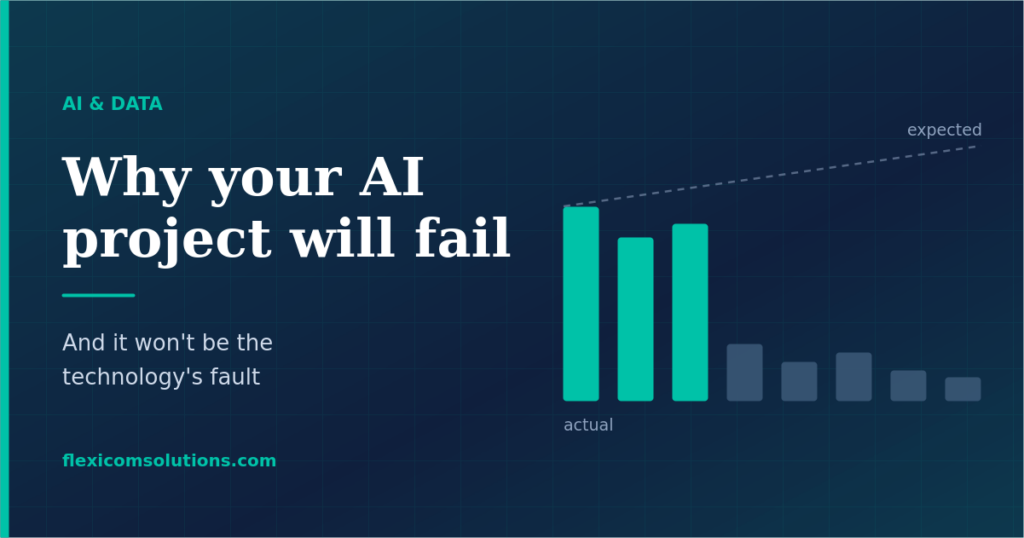
Let me put the uncomfortable part first. In 2025, S&P Global found that 42% of companies scrapped the majority of their AI initiatives — up from 17% the year before. MIT’s research put it more starkly still: around 95% of generative AI pilots stall early and never reach scaled adoption. Adoption has risen sharply. Success has not kept pace.
You would expect, reading the trade press, that the reason is technical. It almost never is.
The pattern behind almost every failure
Here is what actually happens. An organisation identifies that it is behind on AI. It buys a tool. The tool is installed on top of processes that have not changed, staffed by people whose jobs have not changed, drawing on information that was already in poor shape.
The result is not a fixed problem. It is the same problem, running faster — and frequently in front of the customers you were most hoping to impress.
Technology bolted onto unchanged ways of working doesn’t fix the problem. It automates it, visibly.
I have been running transformation programmes for twenty-five years, and this pattern predates AI entirely. It is the same reason CRM implementations fail, the same reason ERP programmes overrun, and the same reason a new phone system doesn’t fix a business that never decided who answers the phone.
Three things nobody puts in the proposal
1. Most of the cost is data, not technology
Industry analysis consistently puts 60–80% of an AI project’s time and cost on preparing data. If your customer information lives across a CRM, four spreadsheets, an inbox and somebody’s laptop, that is your project. The AI part is comparatively trivial.
This is why “we’ll do a discovery phase” often means “we are about to find out how bad your data is, at your expense”. A competent adviser tells you that before you sign, not after.
2. The pilot with no decision point is not a pilot
A genuine pilot has a number attached to it and a date on which someone decides whether it worked. Without both, what you have is an experiment that quietly becomes permanent — nobody wants to admit it failed, so it is neither stopped nor scaled. It simply persists, consuming licence fees and goodwill.
3. Adoption is a separate piece of work, and it is the one that gets cut
When a build overruns — and it will — the training and change budget is the first thing sacrificed, because it feels optional. It is not optional. A tool nobody uses is not a partial success; it is a total failure with an invoice attached.
What works instead
The alternative is unglamorous, which is precisely why it is undersold.
- Pick one internal process, chosen because it is repetitive, well understood and irritating. Quoting. Data entry. First-line enquiry triage. Report assembly.
- Start internal, not customer-facing. If it gets something wrong, a colleague notices — not a client. Customer-facing chatbots are the highest-risk place to begin and, depressingly often, the first thing proposed.
- Use what you already pay for. Microsoft 365, Google Workspace and most modern CRMs now include capable AI features. Many organisations own most of what they need and have never turned it on.
- Agree the measure before you start. Not “improve efficiency”. Something like “reduce quote turnaround from three days to same-day, measured over eight weeks”.
- Change the process and the technology together, in stages, each one proving its value before the next begins.
- Be willing to stop. The organisations that succeed with AI are not the ones that never had a failed pilot. They are the ones that killed the failed pilot at week six instead of year two.
The honest version of the productivity claim
You will read that AI delivers enormous productivity gains. In smaller organisations, the more accurate statement is that it changes what your people spend their time on. If someone currently spends six hours a week assembling a report, that time goes somewhere more useful. That is a real benefit. It is not the same as the headline figures, and anyone quoting those figures at you without qualification is selling.
Equally: the evidence so far is that AI in smaller organisations is largely supporting people rather than replacing them, and most firms using it report no change to headcount at all. If your board is worried about redundancies, that fear is currently ahead of the evidence.
One thing to do this week
Before any of the above, do this. Find out what AI tools your staff are already using. The answer is almost never “none”, and unmanaged use of free tools with client information is a data protection exposure that costs nothing to fix and a great deal to ignore. We wrote about that separately, because it deserves its own conversation.
The uncomfortable conclusion of all this, for anyone in our position, is that the tool is rarely the hard part — and the hard part is not something you can buy. It is deciding which process is worth changing, getting your information into a fit state, and having someone accountable for whether people actually work the new way.
That is unglamorous advice. It is also why it works.
Fractional leadershipDirector-level change leadership, one day a weekTwenty-five years of delivery, trustee and non-executive experience, and a fixed-price Readiness Review to start. Without the full-time hire.How we work