I spent a year as one of fifteen independent commissioners on the Wandsworth Cost of Living Commission. We heard evidence from over ninety witnesses — food banks, advice services, youth groups, carers’ organisations, faith groups, small charities operating on almost nothing.
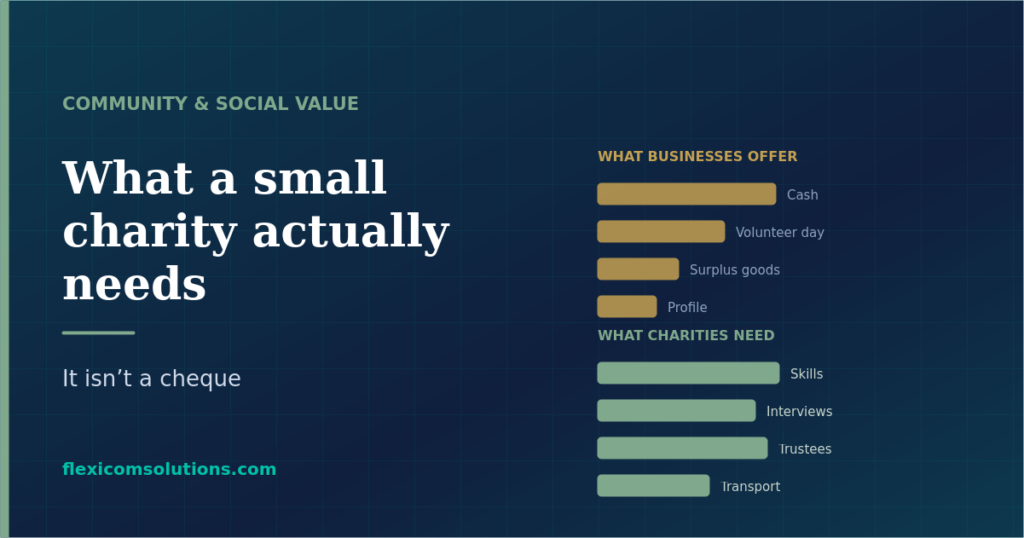
One pattern came up so consistently that it stopped being an observation and became a finding. When businesses offer help, they offer money. When charities describe what they need, they describe something else.
This is not a criticism of business generosity. The goodwill is real and considerable. It is a brokering failure, and brokering failures are fixable.
The two columns
Put simply, here is the mismatch.
What businesses most often offer: cash donations, a one-off volunteering day, surplus goods, awareness and profile.
What small charities most often need: professional skills — HR, finance, legal, digital; guaranteed interviews and employment routes; trustees and board expertise; transport, storage and space.
Money is genuinely useful, and nobody should stop giving it. But it is the most abundant thing on offer and rarely the scarcest thing needed. The second column is chronically short, and it happens to be full of things a professional business already has in quantity.
Trustees: the most valuable thing you are not offering
If I had to name one contribution that changes what a small charity can do, it is a competent trustee.
Small charities are frequently governed by boards with enormous commitment and significant gaps — no one with a finance background, nobody who has managed employment law, nobody who understands digital. The consequences are not abstract. It means decisions get deferred. It means a funder’s governance question causes a scramble. It means the chief executive is effectively unsupervised, which is bad for them as well as for the organisation.
A finance director, an employment lawyer or a digital leader on a small charity board materially changes what that organisation can attempt. And it is not one-directional: for your own people, a trusteeship offers genuine board experience years earlier than they would get it internally. Ask any HR director what they would pay for that in development terms.
Guaranteed interviews beat almost anything
Employability charities run training programmes and then hit a wall: their participants have new skills and no way past an applicant tracking system.
A commitment to interview — not to hire, to interview — candidates who complete a local programme is worth more to that charity than a donation of similar administrative cost. It is the one thing they cannot manufacture for themselves, and it converts their work into outcomes.
It also happens to be measurable, which matters if you are evidencing social value for a tender. “We offered fourteen guaranteed interviews, eleven were taken up, four people were hired, three still in post at six months” is a far stronger claim than a donation figure.
Pro bono time, but scoped
An open-ended offer of professional help sounds generous and often produces nothing, because a stretched charity cannot work out how to use it without spending time it does not have.
Scope it instead. “Two of our HR team, four hours a month, reviewing your employment documentation and answering questions.” Specific, bounded, and easy to say yes to. The best corporate partnerships I saw during the Commission looked like this rather than like a big launch event.
Ask what doesn’t help
Here is the question almost nobody asks, and the one that changes the conversation: what would you rather we didn’t offer?
Charities have answers to this, and they are usually reluctant to volunteer them because they fear appearing ungrateful. During the Commission we heard versions of all of these:
- “We’re tiny — please don’t offer us a committee.”
- “One-off donations create more admin than value for us.”
- “We can’t host large volunteer groups. We have one part-time coordinator.”
- “Our volunteer days are seasonal. Turning up in July doesn’t help.”
- “Please don’t send us food that doesn’t match our clients’ dietary needs.”
Every one of those is a partnership failure prevented by a single question.
Capacity is the constraint nobody accounts for
The most common way a well-intentioned corporate partnership fails is that the charity cannot absorb it. A micro-charity with one coordinator working three days a week is not being difficult when it takes a fortnight to reply. It is being accurate about its capacity.
If you are the larger party, the burden of adapting sits with you. That means longer notice periods, fewer meetings, tolerating slower responses, and never creating a process the charity has to administer on your behalf.
What this means if you’re the one deciding
If you run or advise a business with a community commitment, three questions will get you further than a bigger budget:
- What can we offer that isn’t money? List your professional capabilities, your physical assets, your employment pipeline, your spare capacity.
- What does this specific organisation actually need, and what can it absorb? Ask both. Take the second answer seriously.
- What would they rather we didn’t offer? Then don’t offer it.
None of that requires new budget. It requires a different first conversation — and the reason it doesn’t happen is that nobody is brokering it. That is the gap, and it is a solvable one.
Questions we get asked
What should we offer a charity instead of money?
Professional skills, trustees and board expertise, guaranteed interviews, and practical help such as transport, storage or space. These are chronically short and a professional business already has them.
Why do guaranteed interviews matter more than a donation?
An employability charity can train people but cannot get them past an applicant tracking system. A commitment to interview converts their work into outcomes, and it is measurable for social value reporting.
How do we avoid overwhelming a small charity?
Ask what they can absorb as well as what they need, take the answer seriously, give longer notice, hold fewer meetings, and never create a process they have to administer on your behalf.