I have sat in a lot of strategy days. They are usually good. Intelligent people, a clear-eyed look at the market, an honest assessment of what the organisation is and isn’t, and by late afternoon a set of priorities that everybody in the room genuinely believes in.
Then the room empties, and the interesting part begins.
Because a strategy is not a decision. It is a very large number of subsequent decisions, most of them made by people who were not in the room, under time pressure, with incomplete information, about things the strategy never specifically addressed. The document said “move upmarket”. Nobody wrote down what to do when an existing low-margin client asks for a renewal on Thursday.
That gap — between a strategy that is agreed and a strategy that is happening — is where most of the value is either realised or quietly lost. And it is a genuinely harder discipline than the strategy itself, for a reason that is uncomfortable to say out loud: setting direction is an intellectual exercise, and delivering it is a human one.
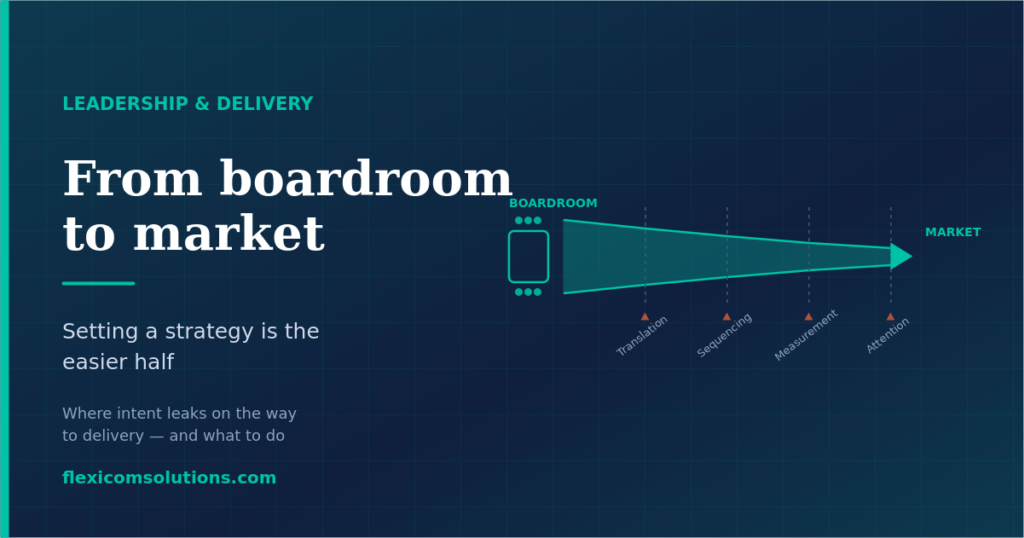
The four places strategy leaks
In twenty-five years of programmes I have seen the same four leaks, in roughly this order. They compound, which is why organisations often cannot say where things went wrong — by the time the shortfall is visible, all four have happened.
1. Translation
A strategy is written in the language of outcomes: grow the enterprise segment, improve retention, become data-led. A person doing their job on Tuesday needs to know what to do differently. Between those two things sits a translation problem that almost nobody owns.
The failure looks like enthusiastic agreement followed by unchanged behaviour. Everyone can recite the strategy. Nothing about the working week is different. And when you ask, individually and kindly, what they have stopped doing in order to do the new thing, the answer is nothing — because nobody told them they could stop anything.
The fix is unglamorous: for each strategic priority, name what starts, what stops, and who is accountable. The “what stops” column is the one that gets skipped and the one that determines whether anything happens. Capacity is finite. A strategy that only adds is a wish list.
2. Sequencing
Most strategies are presented as a portfolio of initiatives, which implicitly suggests they can proceed in parallel. They usually cannot. Some depend on others. Some compete for the same three people. Some cannot start until a data or systems foundation exists that nobody has scoped.
The failure mode is a dozen initiatives all at forty per cent complete, each individually justified, collectively delivering nothing. This is the single most common state I find organisations in when they call someone like me.
Sequencing means being willing to tell a director their priority is going third. That is a political act as much as a planning one, which is precisely why it needs someone with the standing to do it and, ideally, no internal career at stake.
3. Measurement
Strategy documents are full of ambitions and short on numbers that can move within a quarter. “Improve customer experience” cannot be managed. It can only be discussed.
What works is a small number of operational metrics that sit between the daily work and the strategic outcome — measures that a team can actually influence this month and that demonstrably ladder up. In one business I worked with, two measures carried almost the entire strategy: lead-to-cash and ticket-to-resolve. Neither appeared in the strategy document. Both were the mechanism by which it happened.
Finding those measures is diagnostic work, not a reporting exercise. And there should be very few of them. A dashboard with forty indicators is a way of avoiding the question of which two matter.
4. Attention
The final leak is the quietest. A strategy competes for executive attention with everything else, and everything else has deadlines. Six months in, the strategy is still nominally the priority, but the steering group has slipped to monthly, then bi-monthly, and the papers are read in the meeting.
Nothing is formally abandoned. It simply decays. This is how organisations end up two years later with a strategy nobody disowns and nobody is delivering.
The counter is rhythm: short cycles with a decision at the end of each, and a standing forum whose only agenda is trade-offs. Not progress reporting — trade-offs. If a governance meeting never changes a decision, it is theatre, and everyone attending knows it.
Why “operationalising” is the right, ugly word
I dislike the word and use it anyway, because the alternatives are worse. “Implementation” suggests a plan being executed as written, which is not what happens. “Execution” implies the hard thinking is done. Neither captures the actual work, which is closer to translation under uncertainty — continuously converting intent into decisions while the ground moves.
A strategy is a hypothesis about where value lies. Operationalising it is the process of testing that hypothesis in contact with reality, and being honest when reality disagrees.
That last clause is where most of the difficulty sits. Delivery reveals things about a strategy that a strategy day cannot: that the enterprise segment has a longer sales cycle than assumed, that the data needed for personalisation does not exist in usable form, that the two people who could lead the new proposition are already fully committed.
An organisation that treats those findings as delivery failures will bury them. One that treats them as information will adjust — and adjusting a strategy on evidence is not a retreat, it is the entire point.
What good looks like in practice
When this is working, four things are visible from the outside.
- Someone can tell you what was stopped. Not what was started — anyone can list new initiatives. What was deliberately discontinued to make room.
- The sequence is explicit and somebody defends it. Including to the directors whose priority is not first.
- There are two or three operational measures, reported often, that people recognise as their own. Not a scorecard assembled for the board.
- Decisions get made in ninety-day cycles, and at least one of them has been to stop something that wasn’t working.
None of that requires a large programme office. It requires someone senior whose actual job is holding the line between intent and activity, when the pressure at every point is to add rather than choose.
The awkward question about capability
Most organisations of any size have strategy capability. The board has it, or buys it. Far fewer have the delivery discipline to convert it, and it is a different skill — closer to programme leadership and organisational judgement than to analysis.
Hiring for it permanently is expensive and often mismatched: the need is intense for twelve to eighteen months and then substantially reduces. Which is precisely why fractional arrangements work here, when they work at all. You need the seniority for the political parts and the availability for the unglamorous parts, without the permanent cost of either.
The honest test of whether you need help is not whether your strategy is good. It probably is. It is whether you can answer the four questions in the section above without hesitating.
If you can, you are in better shape than most and this post has told you nothing new. If two of them made you pause, that is where the value is leaking — and it is a fixable, well-understood problem rather than a mysterious one.
Questions we get asked
What does operationalising strategy actually mean?
Continuously converting strategic intent into day-to-day decisions while conditions change. It is closer to translation under uncertainty than to executing a fixed plan, because most of the decisions that determine the outcome were never specifically addressed by the strategy.
Why do good strategies fail in delivery?
Four leaks, usually in sequence: no translation into what starts and stops, no honest sequencing of competing initiatives, no operational measures that move within a quarter, and a gradual loss of executive attention that nobody formally decides on.
How many metrics should a strategy be managed by?
Very few. Two or three operational measures a team can influence this month and that demonstrably ladder up to the strategic outcome. A dashboard with forty indicators is a way of avoiding the question of which two matter.
Should we hire permanently for delivery capability?
Often not. The need is intense for twelve to eighteen months and then reduces substantially, which makes a permanent senior hire an expensive mismatch. That profile is why fractional arrangements suit this work.