There is a particular kind of frustration I hear from smaller businesses that bid for public sector work. They lose, they ask for feedback, and the feedback says their social value response scored poorly. They are baffled — because they do more for their local community than the competitor who won.
Usually they are telling the truth. And usually they still deserved to lose those marks.
Why genuine community work scores badly
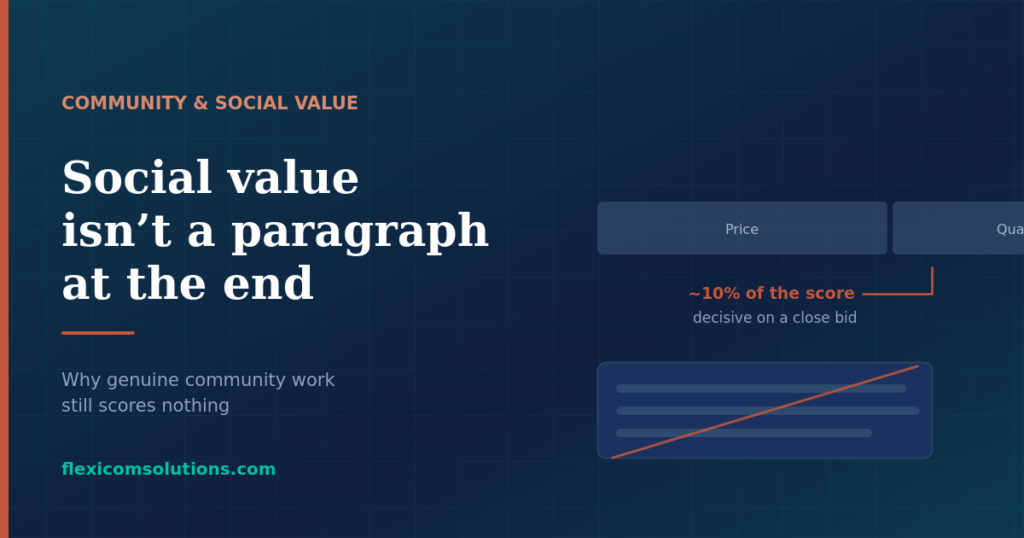
Social value is typically weighted around 10% of the total score in public sector procurement. On a close bid that is decisive. But it is scored, like everything else in a tender, against what you wrote — not against what you did.
The classic failing response looks like this: a paragraph, written last, describing how the company is committed to supporting the local community, mentions a charity it has donated to, and affirms that it takes corporate social responsibility seriously.
An evaluator cannot award marks for that. There is nothing to score. No baseline, no quantity, no timeframe, no method of verification, and no commitment about what will happen on this contract.
The distinction that decides the marks
Almost every weak response conflates two different things, and evaluators score them separately.
Track record is what you have already done. It is evidence that you can be believed. It should be specific, quantified and verifiable.
Commitment is what you will do in delivering this contract. It should be specific, measurable, and deliverable — because if you win, it becomes contractual.
A response that describes only track record reads as “we’re nice people.” One that offers only commitments reads as unevidenced promises. You need both, clearly separated, with the commitment scaled from the track record so it is credible.
What “specific” actually looks like
Compare these two.
Weak: “We are committed to supporting local employment and work closely with community organisations in the borough.”
Scoreable: “Over the past nine months we have offered fourteen guaranteed interviews to candidates completing the training programme at [organisation]. Eleven were taken up and four people were hired, of whom three remain in post at six months. On this contract we will extend that commitment to a minimum of eight guaranteed interviews per year, reported quarterly to the contract manager.”
The second is not better writing. It is better recording. Nobody could write it without having captured those numbers as the work happened.
The two-column discipline
Here is the single most useful habit I can offer anyone bidding for public work: keep your social value evidence in two clearly separated columns.
Verified. Things confirmed by both parties — hours logged, interviews offered and taken up, equipment donated with receipts, placements made. These you can state as fact.
Your own estimates. The value of pro bono time at your internal charge-out rate, the replacement cost of donated goods, anything self-reported. These you can use, but you must attribute them as your own estimate.
The reason this matters is defensive. An evaluator who spots an unverifiable figure presented as fact may reasonably discount the whole answer, including the parts that were solid. Being visibly careful about what you can and cannot substantiate makes the substantiated parts more credible, not less.
Commitments become contractual. Read that again.
This is the part that catches people out after they win.
Social value commitments in a winning bid are contract terms. If you promised twelve apprenticeships and delivered four, that is a performance failure with the same status as missing a delivery deadline. It affects your relationship with that client and your record for future bids.
Which means the discipline runs in both directions: be specific enough to score, and modest enough to deliver. Bidding teams under pressure routinely inflate this section because it feels softer than the technical response. It is not softer. It is just enforced later.
Start recording before you need it
The reason most SMEs cannot write a strong social value response is not that they lack activity. It is that the activity was never recorded in a usable form, and reconstructing it a year later from memory and email produces exactly the vague paragraph that scores nothing.
The fix is unglamorous. When you do something, write down what it was, how much of it, who confirmed it, and when. Four fields. A spreadsheet is fine.
Do that for twelve months and your next social value response writes itself — and it will be demonstrably stronger than a competitor who did more and recorded less.
A note on the wider point
There is a version of this that treats social value purely as a scoring exercise, which I find slightly depressing and also counterproductive. The businesses that score well on social value tend to be the ones doing it for its own reasons and simply keeping records.
The ones that struggle are usually trying to construct a story after the fact — and evaluators, who read hundreds of these, can tell the difference immediately.
Questions we get asked