I have spent twenty-five years doing this work and I have become steadily more uncomfortable with the phrase that describes it.
“Digital transformation” is now in poor health. It arrives in proposals as a category rather than a claim, and among senior people it increasingly functions as a tell — a signal that whoever wrote it is describing an activity rather than an outcome. I still use it, because the alternatives are worse. But I want to say plainly what I think it means, because the gap between the phrase and the practice is where a great deal of money disappears.
Here is the position, and it is not a neutral one.
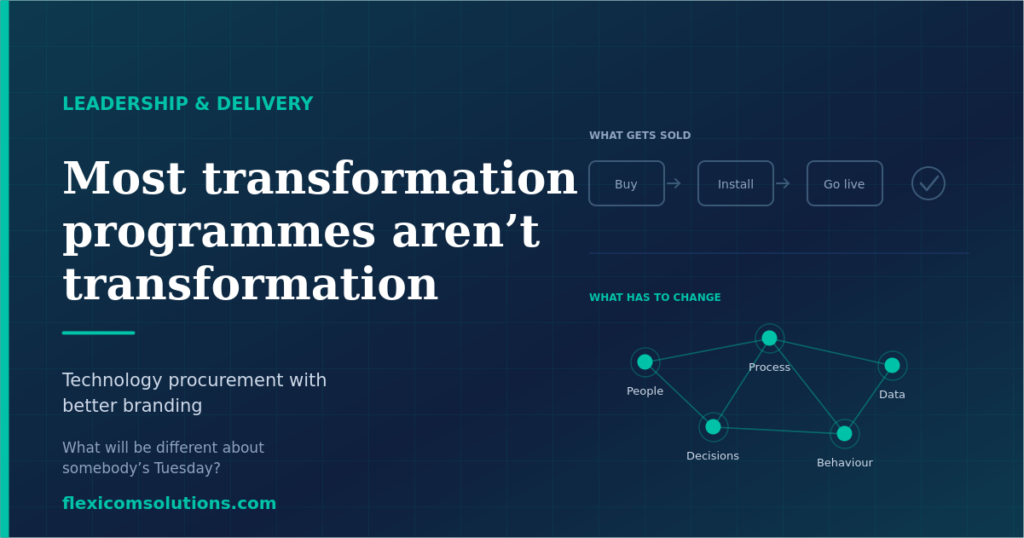
Most of what is sold as digital transformation is technology procurement with better branding. The transformation is the change in how people work — and almost nobody sells that, because it cannot be invoiced as a licence.
The test I apply
There is a simple question that separates the two, and I ask it early because the answer determines everything that follows.
If this programme succeeds completely, what will be different about somebody’s Tuesday?
Not what system they will be using. What decision they will make differently, what they will stop doing, what will take an hour instead of a day. If nobody can answer that in concrete terms, the programme is an implementation. It may be a perfectly sensible implementation — sometimes you genuinely just need a better phone system — but it should be costed, governed and described as one.
The reason this matters commercially is that implementations and transformations fail for different reasons and need different disciplines. Treating one as the other is how organisations end up with excellent technology and unchanged results.
Four things I think are true
1. The technology is rarely the constraint
In fifteen years of independent work and ten before that inside a large organisation, I have almost never seen a programme fail because the software could not do the job. They fail on data nobody owns, decisions nobody makes, and adoption nobody drives.
This is inconvenient for everyone involved, because the technology is the part with a demo, a price and a delivery date. The other three are ambiguous, political and hard to put on a Gantt chart. So attention flows to the tractable problem and away from the actual one.
2. Transformation is subtraction before it is addition
Every organisation I have worked with can list what it is starting. Very few can tell you what they have stopped.
Capacity is finite. A programme that only adds — new system, new process, new reporting line, new meeting — is not a transformation, it is an accumulation. And people who have not been told what they may stop doing will keep doing all of it, badly, while quietly concluding that the new thing is a burden rather than a benefit.
The most useful hour in many programmes is the one spent deciding, explicitly and in writing, what stops. It is also the hour most likely to be skipped, because it requires someone senior to take something away from someone who values it.
3. Digital is a means, and treating it as an end distorts the decision
Once “become digital” is the goal, every proposal is judged on how digital it is rather than on what it changes. That is how organisations end up automating a process that should have been eliminated, or building a customer portal for a journey that nobody wanted to complete in the first place.
I have more than once advised a client that the answer was to stop offering a service rather than to digitise it. That advice is not commercially convenient for me. It has also been correct.
4. The organisation you are transforming has opinions
Strategy treats an organisation as a system to be reconfigured. It is actually several hundred people with careers, reputations, workloads and a well-founded suspicion of the last three initiatives.
None of that is resistance to change in the pejorative sense. It is a rational response to having been asked to absorb change before, at cost to themselves, with mixed results. Any approach that treats it as an obstacle to be communicated past will fail, and deserve to.
The people who have been there longest usually know precisely why the last attempt did not work. Asking them is cheaper than discovering it independently in month nine.
So what does it mean, when it means something?
Here is the definition I would defend.
Digital transformation is a sustained change in how an organisation makes decisions and delivers value, enabled by technology and evidenced by different behaviour.
Three parts of that are load-bearing.
Sustained. A change that reverts when attention moves elsewhere was a project, not a transformation. Which means the test is applied twelve months after go-live, not at launch.
Enabled by technology. Not constituted by it. The technology is necessary and insufficient, which is an uncomfortable thing for a firm that sells technology to say and a necessary thing for anyone advising on it.
Evidenced by different behaviour. Not by a completed implementation, a satisfied steering group or a positive internal survey. By people demonstrably working differently, in a way that shows up in a number somebody cares about.
Why this matters more for smaller organisations
A large enterprise can absorb a failed programme. It becomes a line in a write-off, a lesson in a post-implementation review, and everybody moves on.
An organisation of twenty to two hundred and fifty people cannot. A failed programme consumes cash it does not have spare, the attention of people with no slack, and — most expensively — the organisation’s appetite for the next attempt. I have walked into businesses where the real obstacle was not the current problem but the memory of the last project, and that is a considerably harder thing to fix.
Which is why I am cautious in a way that sometimes costs me work. A smaller organisation should do less, in smaller stages, with a decision point at the end of each, and should be genuinely willing to stop. That is not timidity. It is the correct risk posture for someone who cannot afford to be wrong at scale.
What I would want a reader to take away
If you are being sold a transformation, three questions will tell you most of what you need to know.
- What will be different about somebody’s Tuesday? If the answer is only “they’ll be using the new system”, you are buying an implementation.
- What are we going to stop doing? If nothing, the plan is not finished.
- What is the first measurable outcome, and when? If it is more than ninety days away, or there isn’t one, ask why.
None of those require you to understand the technology. They are questions about intent and honesty, and the quality of the answers tells you a great deal about who you are dealing with — including, reasonably, about me.
I have written elsewhere about where strategy leaks on the way to delivery, and about why most AI projects fail for exactly the reasons set out above. This is the position underneath both.
Questions we get asked
What is the difference between digital transformation and an IT project?
An implementation changes what system people use. A transformation changes how they work, and is evidenced by different behaviour rather than by a completed install. Both can be worthwhile, but they fail for different reasons and need different disciplines, so they should be costed and governed differently.
How can I tell whether a proposal is genuine transformation?
Ask what will be different about somebody's Tuesday if it succeeds completely. If the answer is only that they will be using the new system, you are buying an implementation.
Why do transformation programmes fail?
Rarely because the technology could not do the job. Usually because of data nobody owns, decisions nobody makes, and adoption nobody drives — all of which are harder to plan than the technology and so receive less attention.
Why is a failed programme worse for a smaller organisation?
A large enterprise absorbs it as a write-off. An organisation of twenty to two hundred and fifty people loses cash it has no spare of, the attention of people with no slack, and its appetite for the next attempt — which is the most expensive of the three to recover.